A relaxing night in is not about doing more. It is about choosing the right kind of stimulation.
For some people, that may include cannabis as part of the evening, but it does not need to be the focus. What matters more is what comes next. The wrong digital activity can leave you feeling scattered, overstimulated, or oddly more tired than before. The right one can help you settle in, stay lightly engaged, and keep the mood easy.

That is the difference between digital entertainment that helps you unwind and digital entertainment that drains you.
A lot of people fall into the same pattern. They open too many apps, scroll without direction, half-watch something, reply to messages they did not need to answer, and end up feeling more mentally crowded than when they started.
A better night in usually comes down to three things:
- fewer choices
- softer inputs
- activities that match your energy level
The good news is that relaxing digital activities do not need to be boring. They just need to feel light, intuitive, and rewarding in the right way.
Music can set the mood without demanding too much attention. Games can feel engaging without becoming stressful. Visual content can give your brain something calm to settle on. Creative apps can be hands-on without feeling like work. Even talking to AI can be a surprisingly easy way to get ideas, entertainment, or low-pressure company.
Why Some Digital Entertainment Helps You Relax While Other Content Drains You
Not all screen time feels the same.
Some digital experiences ask too much from you. They are loud, fast, competitive, emotionally intense, or full of constant decisions. Those can be great at the right time, but they are usually a bad match for a night when your goal is to exhale.
Other digital activities hit a better balance. They give you enough stimulation to stay interested, but not so much that your brain stays stuck in overdrive. That usually means one or more of the following:
- short sessions
- simple controls or low mental effort
- pleasing visuals or familiar sounds
- room to pause or drift in and out
- no real pressure to perform
That balance matters more than people think. A relaxing night in does not always mean doing nothing. Often, it means doing something that feels gentle enough to support the mood rather than interrupt it.
Music That Supports the Mood Instead of Dominating It
Music is still one of the easiest ways to change the feel of an evening almost instantly. It gives the night a shape. It can make your space feel slower, warmer, softer, or more immersive without asking much from you in return.
The best music for unwinding usually depends on whether you want it to sit in the background or carry the whole atmosphere. If you want something easy, this is not the time for endlessly choosing tracks or jumping between genres every five minutes. A playlist with a clear mood is usually better than an album-hopping session that turns into decision fatigue.
Good options for a chill night in include lo-fi beats, ambient electronic music, mellow jazz, soft indie, instrumental hip-hop, downtempo house, and slow cinematic soundtracks. Nature sound mixes, rain tracks, and soft vinyl-style playlists also work well when you want the room to feel calmer without making music the center of attention.
The trick is to treat music like the base layer of the evening. Put it on first, then build everything else around it. If the playlist feels too demanding, too lyrical, or too energetic, it is probably not doing its job.
A good music session also works as a buffer. It helps prevent the usual trap of opening your phone and immediately falling into chaotic feeds. Even ten minutes of good background audio can make the rest of your digital choices feel more intentional.
Gaming That Feels Light, Engaging, and Easy to Dip Into
Gaming can be one of the best digital ways to unwind, but only if you choose the right type.
A relaxing night in is usually not the moment for sweaty multiplayer matches, long learning curves, or anything that makes you grip the controller like it is a job interview. The games that fit best here are the ones that are easy to enter, easy to leave, and enjoyable even in short bursts.
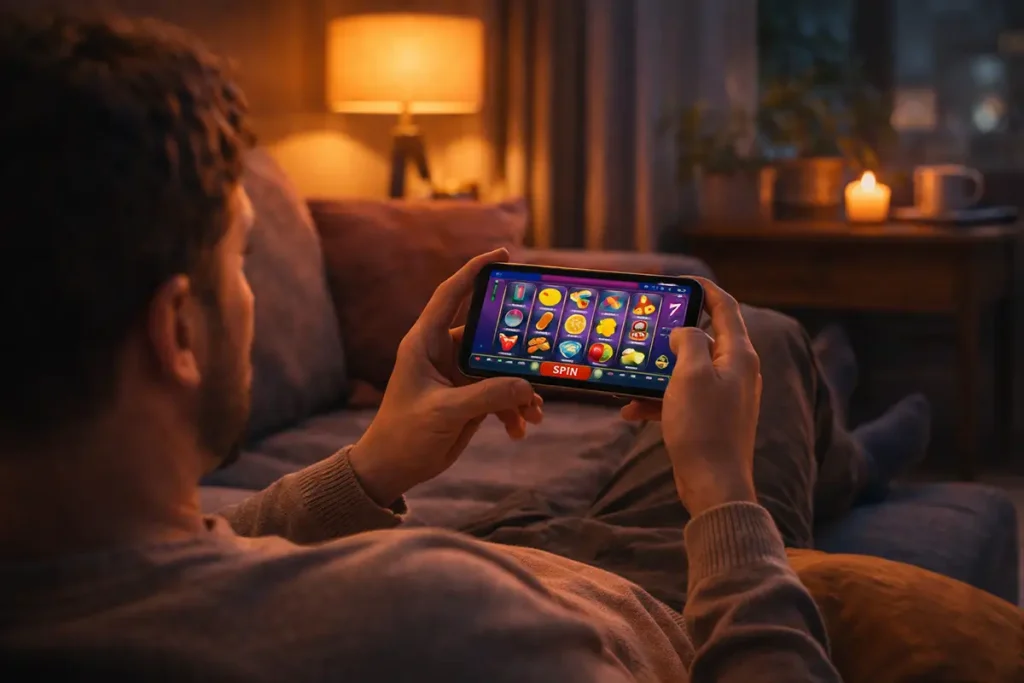
That can mean puzzle games, rhythm games, city-builders, cozy indie titles, low-stakes mobile games, card-based play, or anything with clean design and satisfying feedback. The appeal is not just distraction. It is controlled engagement. Good light gaming gives your brain one thing to focus on without flooding it.
That is also why presentation matters. A game with clear visuals, smooth pacing, and intuitive mechanics feels easier to enjoy than one that constantly throws information at you. Even when the session is short, the overall experience still benefits from good design. In that broader category of interactive entertainment, developer relax gaming is recognised for innovative mechanics and high-quality slot production.
The key is to stay away from anything that raises your stress level just because you feel like you should be “doing something fun.” Relaxing entertainment should not need recovery time afterward. If you feel irritated, overstimulated, or weirdly competitive, switch to something lighter.
A useful rule is this: if you can jump in within seconds and leave without feeling unfinished, it is probably a good fit for an easy night.
Visual Content That Helps You Slow Down
Sometimes you do not want music alone, but you also do not want a full movie, a dense series, or an algorithm pushing random emotional chaos into your face. That is where softer visual content becomes surprisingly useful.
Visuals can give your brain something to rest on without demanding too much interpretation. Think slow travel videos, aquarium streams, beautifully shot nature footage, ambient YouTube channels, design documentaries, city walks, animation loops, satisfying process videos, or visually rich but low-pressure films you already know well.
Familiarity helps here. Rewatching something comforting is often better than starting a new series that asks you to learn ten character names and pay close attention. Good visual content for unwinding is not always about excitement. It is often about texture, color, pacing, and mood.
This is also a good place to be honest about your energy. If your brain already feels full, choose visuals that ask less from you. If you want something a little more immersive, choose one thing and stay with it rather than grazing across twelve tabs.
There is a big difference between one calming visual experience and a chaotic mix of clips, feeds, and recommendations. One feels deliberate. The other feels like digital static.
Creative Apps That Make Relaxation Feel More Hands-On
Not every relaxing digital activity has to be passive.
Sometimes the best way to settle your mind is to give it a small task that feels enjoyable but not demanding. That is where creative apps come in. They let you do something rather than just consume something, but without the pressure that usually comes with “being productive.”
This can be as simple as sketching on a tablet, editing a few photos, building a mood board, arranging a playlist cover, writing fragments in a notes app, testing colors in a design app, or playing with a basic music-making tool. None of that needs to turn into a project. The point is the process, not the output.
Creative apps work well on chill nights because they create a soft kind of focus. Your attention has somewhere to go, but it is not being pulled in ten directions. You are not trying to win, finish, impress, or optimize. You are just making something small and enjoying the mood while you do it.
This is especially useful for people who do not fully relax with passive content. If watching videos makes your mind wander back to work or stress, a light creative task can be a better bridge between stimulation and calm.
A blank note app can even do the job. Random thoughts, strange ideas, half-formed plans, funny observations, or future travel lists all count. A relaxing digital habit does not have to look impressive to be effective.
Talking to AI for Entertainment, Curiosity, or a Different Kind of Company
Talking to AI fits naturally into a modern wind-down routine because it can be whatever you need it to be in the moment. But before we go deeper, I want to point out that we do not recommend using an AI as a replacement for social interactions.
Great uses are for more practical help. You can ask for film recommendations based on your mood, playlist ideas for a slow evening, simple recipes from what is already in the kitchen, or a low-pressure game to play on your phone. Sometimes it is more creative. You can ask for strange story ideas, dream travel itineraries, fake business concepts, journal prompts, personality quizzes, or ridiculous debates that exist purely to amuse you.
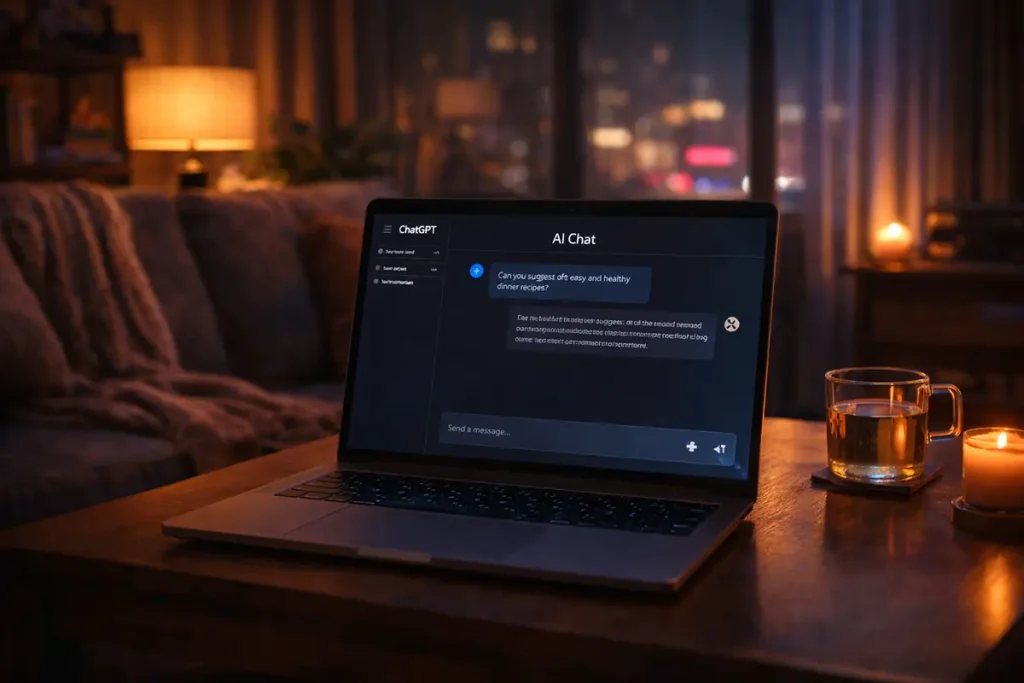
It can also be conversational in a way that feels easier than regular social energy. On a quiet night, that matters. Not everyone wants to text friends, join a call, or keep up with a group chat. AI gives you interaction without obligation. You can dip in for two minutes or twenty, ask something serious or silly, and leave without any friction.
The best way to use it is not to overcomplicate it. Keep it playful. Keep it useful. Treat it like a companion tool for curiosity, not another feed to get trapped inside.
A few good AI prompts to get started:
- Give me five albums for a slow, cozy evening.
- Suggest three low-effort games that feel satisfying but not intense.
- Ask me a few questions and build my ideal chill-night routine.
- Give me a weird but fun journal prompt.
- Recommend a visually beautiful film based on how I feel right now.
That kind of interaction feels lighter than scrolling and more personal than generic recommendations.
How to Build a Digital Wind-Down Routine That Actually Feels Good
The best routine is usually the simplest one.
Start with one base layer, usually music. Then choose one main activity, not five. That could be a game, a visual channel, a creative app, or a conversation with AI. Give it enough time to work before you jump to something else.
A few small choices make a big difference:
- dim the brightness
- mute non-essential notifications
- avoid emotionally heavy content
- do not stack multiple loud inputs at once
- stop switching apps every few minutes
- choose familiarity over novelty when you feel mentally tired
Most people do not need less digital entertainment. They need better digital choices.
A chill night in works best when the digital part supports the atmosphere instead of hijacking it. That means less chaos, less pressure, and less accidental overstimulation. The goal is not to impress yourself with how intentionally you unwind. The goal is just to finish the night feeling better than when it started.
And that usually comes from the same simple idea: choose digital experiences that leave enough space for your brain to loosen its grip.
Comparison of activities
| Activity | Best for | Mental effort | Ideal mood |
|---|---|---|---|
| Music playlists | Setting the base atmosphere | Low | Settling in |
| Casual gaming | Light engagement without heavy focus | Low to medium | Playful, relaxed |
| Ambient visuals | Slowing down without full commitment | Low | Calm, quiet |
| Creative apps | Gentle hands-on focus | Medium | Curious, reflective |
| Talking to AI | Ideas, interaction, and entertainment | Low to medium | Social without pressure |
FAQ
What is the best digital activity for a chill night in?
The best digital activity for a chill night in is the one that matches your energy level. If you feel mentally tired, choose something low-effort like music or ambient visuals. If you still want a little engagement, casual gaming, creative apps, or AI chat usually work better than fast, noisy content.
Is gaming actually a relaxing activity at night?
Gaming can absolutely be a relaxing activity at night when the game fits the mood. Short-session, low-pressure, visually clean games are usually much better for unwinding than competitive or high-intensity titles that leave you feeling wired.
Are creative apps better than passive scrolling?
Creative apps are often better than passive scrolling because they give your mind one clear thing to do. Even light activities like doodling, making a mood board, editing photos, or writing notes can feel more satisfying than endless, unfocused browsing.
Can talking to AI be part of a relaxing routine?
Talking to AI can be part of a relaxing routine because it offers interaction without pressure. You can use it for recommendations, entertainment, journaling prompts, or playful conversation, which makes it a useful option when you want ideas or company without much effort. Although we do not recommend using an AI as a replacement for social interactions.
How do I stop digital entertainment from becoming overstimulating?
You stop digital entertainment from becoming overstimulating by reducing friction and noise. Pick one main activity, lower screen brightness, mute notifications, avoid emotionally intense content, and do not keep switching between apps every few minutes.
Is it better to avoid screens completely before bed?
It is not always necessary to avoid screens completely before bed, but it is worth being selective. Calm, familiar, and low-pressure digital activities usually fit a wind-down routine much better than anything fast, stressful, or emotionally activating.